

Yes — and when done intentionally, mixing two countertop materials in the same kitchen is one of the most sophisticated design moves available in 2026. The most common combination is granite or quartz on the perimeter countertops paired with a different stone on the island. For homeowners planning kitchen countertops in Kettering, OH, Granite Empire of Cincinnati fabricates and installs multiple materials in a single kitchen — granite starting at $45/SF and quartz at $55/SF — with the full project completed in 5–7 business days.
The key is intentionality. Mixed materials that look designed and deliberate elevate a kitchen. Mixed materials that look accidental or mismatched undermine the entire space.
Why Would You Use Two Different Countertop Materials in a Kitchen?
There are three practical reasons homeowners choose to mix materials — and all three are legitimate design decisions rather than compromises.
1. Function-driven selection
Different areas of the kitchen serve different purposes. A granite perimeter handles daily cooking tasks, heat from the stove, and general wear. A marble island serves as a dedicated baking and prep surface — marble’s cool temperature is genuinely useful for pastry work. Using each material where it performs best is a functional decision as much as an aesthetic one.
2. Budget allocation
Mixing materials allows homeowners to allocate the budget strategically. Using granite at $45/SF on the perimeter countertops and reserving the higher-cost material (quartz at $55/SF, or marble at $55/SF) for the island — the most visible surface — maximizes visual impact while managing overall project cost.
3. Design intentionality
The island is increasingly treated as a furniture piece in open-concept kitchens — a visual anchor for the whole space. Using a contrasting or complementary stone on the island creates definition, focal point, and design interest that a single material throughout can’t achieve.
What Are the Most Popular Two-Material Combinations for Kitchens?
Certain combinations consistently work in kitchen design — and are among the most frequently requested at Granite Empire of Cincinnati for kitchen countertops in Kettering, OH.
Granite perimeter + Marble island
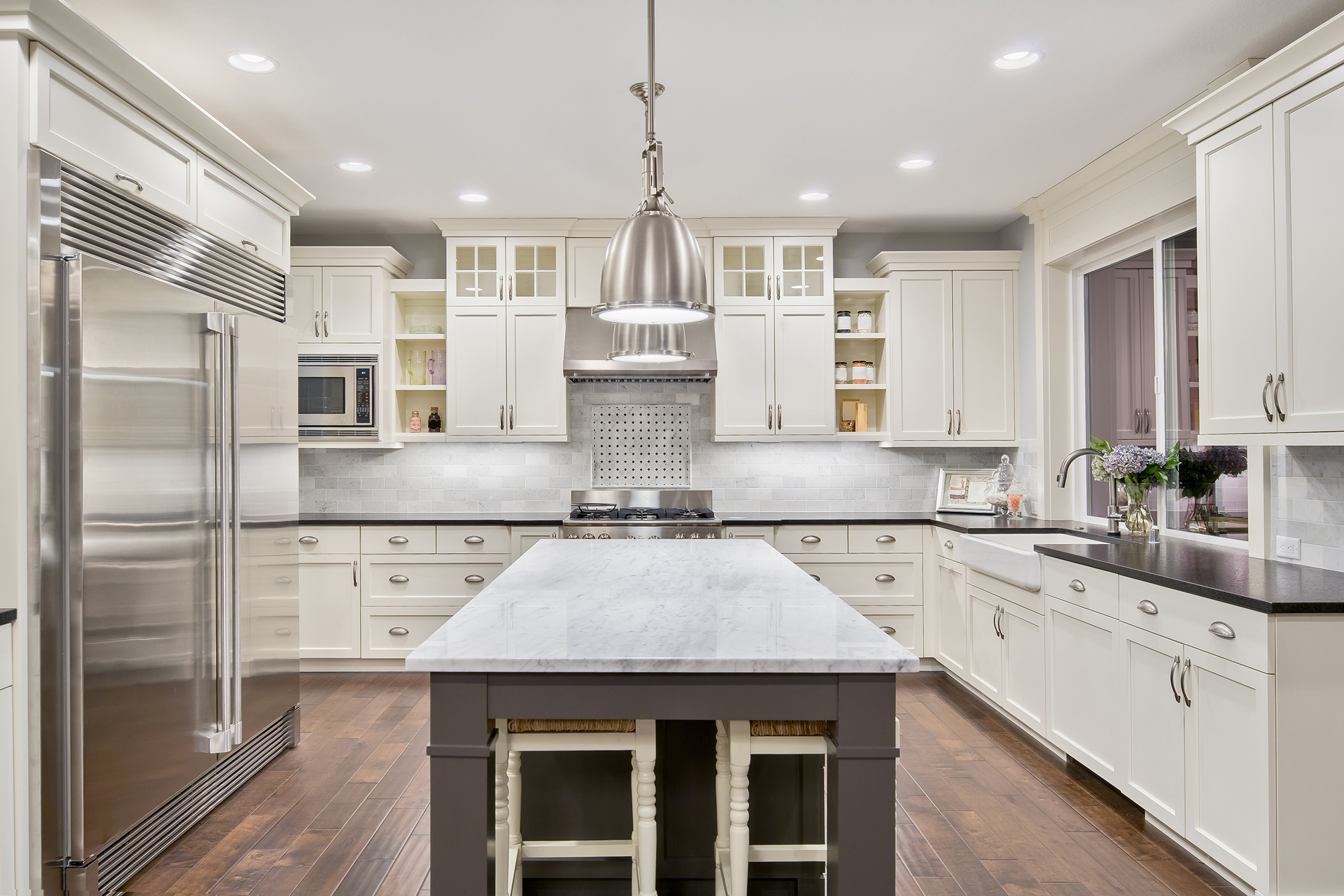
The classic combination. Granite handles the heavy daily work of cooking and food prep around the perimeter; marble on the island provides an elegant, visually distinctive focal point. Both are natural stones, so they share an organic quality that makes them compatible. Works best when the granite and marble share at least one color element — both white-based, or both with similar veining undertones.
Granite perimeter + Quartz island
The practical combination. Granite on the perimeter for cost efficiency at $45/SF; quartz on the island for maximum stain resistance and zero maintenance on the most-used prep surface. Crystal White or White Lace quartz island paired with Dallas White or Luna Pearl granite perimeter creates a cohesive, modern aesthetic.
Quartz perimeter + Marble island
The luxury combination. Quartz everywhere else for effortless maintenance; marble on the island for visual drama and baking utility. This works well in higher-end kitchens where the design statement matters and budget allows for marble’s higher maintenance on a lower-traffic surface.
Same material, different colors
Using the same material — granite or quartz — in two different colors is the easiest way to achieve the mixed-surface look without material compatibility concerns. White Sparkle granite perimeter with Ubatuba Green granite island, for example, creates dramatic contrast while maintaining the cohesion of a single material type.
What Are the Rules for Mixing Countertop Materials Successfully?
Three design principles make the difference between a mixed-material kitchen that looks intentional and one that looks like a mistake:
Rule 1: Share at least one color element
The two materials should have at least one color in common — both white-based, both with gray veining, or both with warm cream tones. This creates visual cohesion even when the materials are clearly different. A warm cream Giallo Ornamental granite perimeter and a soft white Bianco Absoluto quartz island share the warm-neutral family; they look designed together. A cool blue-gray granite perimeter and a warm gold marble island share nothing — they look random.
Rule 2: Create clear definition between materials
The transition between two materials should happen at a natural architectural break — the edge of an island, a change in counter height, a peninsula end. Avoid running two different materials on the same continuous counter run — the seam between them will read as a mistake rather than a design choice.
Rule 3: Let one material lead
One material should cover more surface area and act as the dominant element; the other plays the accent role. Roughly 70/30 is the visual balance that reads as intentional — typically the perimeter countertops in one material (larger area) and the island in another (accent role).
Does Mixing Materials Cost More Than Using One Material Throughout?
It depends on the combination — but it doesn’t have to cost more, and it often costs less than using a premium material throughout.
| Scenario | Estimated Cost |
| All granite — 50 SF | $1,999 (package) |
| All quartz — 50 SF | $3,000 (package) |
| Granite perimeter (35 SF) + Quartz island (15 SF) | ~$2,400 – $2,800 est. |
| Granite perimeter (35 SF) + Marble island (15 SF) | ~$2,300 – $2,700 est. |
| All marble — 50 SF | $3,500 – $5,000+ |
| Quartz perimeter (35 SF) + Marble island (15 SF) | ~$3,200 – $4,000 est. |
The most budget-efficient mixed-material approach is granite on the perimeter — taking advantage of the $1,999 package pricing — with a smaller quartz or marble island quoted separately. The island’s smaller square footage means the premium material cost is manageable even when the per-SF cost is higher.
Granite Empire of Cincinnati provides quotes for mixed-material projects with transparent per-material pricing. Call (513) 547-3711 for a project-specific estimate.
What Granite and Quartz Colors Work Best Together in a Mixed Kitchen?
Specific color pairings that work consistently together at Granite Empire of Cincinnati:
Granite perimeter + Quartz island combinations:
| Granite Perimeter | Quartz Island | Result |
| Dallas White | White Lace | Cohesive white-on-white with subtle variation |
| Luna Pearl | Bianco Absoluto | Soft gray perimeter, warm white island — harmonious |
| White Sparkle | Crystal White | Bright, contemporary, seamless transition |
| Giallo Ornamental | Mystique White | Warm gold perimeter, soft white island — classic |
Granite perimeter + Granite island (different color) combinations:
| Granite Perimeter | Granite Island | Result |
| Dallas White | Ubatuba Green | High contrast — bold statement kitchen |
| Luna Pearl | Giallo Ornamental | Soft gray perimeter, warm gold island — transitional |
| White Sparkle | Gray Star | Bright perimeter, grounded island — balanced |
How Does Granite Empire of Cincinnati Handle Mixed-Material Projects?
Granite Empire of Cincinnati fabricates both materials in-house, which means the measurement, fabrication, and installation for a mixed-material kitchen is handled by one team with one timeline — no coordinating between two separate fabricators.
The process for a mixed-material kitchen:
- Day 1 — Showroom consultation; select both materials and colors; view full slabs for each
- Day 2 — In-home measurement; templates created for perimeter and island separately
- Days 3–5 — Both materials fabricated in-house simultaneously
- Days 5–7 — Single installation appointment covers both materials; perimeter and island installed in the same visit
This single-team, single-timeline approach is the primary advantage of working with an in-house fabricator for mixed-material kitchen countertops in Kettering, OH — rather than sourcing two materials from different companies and coordinating two separate installations.
What Are the Best Material Combinations for Specific Kitchen Styles?
| Kitchen Style | Perimeter Material | Island Material | Why It Works |
| Modern/contemporary | Quartz (Crystal White) | Quartz (contrasting color) | Controlled, consistent aesthetic |
| Transitional | Granite (Luna Pearl) | Quartz (White Lace) | Natural meets engineered elegantly |
| Traditional | Granite (Giallo Ornamental) | Marble (Carrara) | Both natural, warm, classic |
| Farmhouse | Granite (Dallas White) | Marble (Carrara) | White-on-white with organic variation |
| Bold/statement | Granite (Dallas White) | Granite (Ubatuba Green) | Maximum contrast, maximum impact |
| Scandinavian | Quartz (White Lace) | Quartz (Bianco Absoluto) | Clean, minimal, cohesive |

Is a Mixed-Material Kitchen Harder to Maintain?
Only marginally — and the maintenance difference is easily managed with a basic routine.
- Granite areas require annual sealing — a 30-minute DIY task with products costing $15–$50
- Quartz areas require no sealing — ever
- Marble areas require sealing every 6–12 months
If the perimeter is granite and the island is quartz, you seal the perimeter once a year and do nothing special for the island — a very manageable split. If both are granite in different colors, the maintenance routine is identical across both surfaces.
The only scenario that adds meaningful maintenance complexity is including marble — its 6–12 month sealing requirement and etching sensitivity means the marble surface needs more attention than the granite or quartz portions of the kitchen.
Frequently Asked Questions
Is it okay to mix granite and quartz in the same kitchen?
Yes — it’s one of the most popular kitchen design decisions in 2026. Granite and quartz are both natural stone-based materials that share visual compatibility when colors are chosen thoughtfully. The combination of granite’s organic variation and quartz’s consistent pattern creates intentional contrast that elevates both materials.
Does mixing countertop materials affect resale value?
No — and in some markets, a well-executed mixed-material kitchen commands a premium over a single-material kitchen. Buyers interpret mixed materials as a designed, considered kitchen rather than a standard one. The key is that the combination looks intentional; a poorly matched mix can work against resale.
How do I know if two countertop materials will look good together?
Visit the Granite Empire of Cincinnati showroom at 9474 Princeton Glendale Rd, Hamilton, OH and hold slab samples from both materials next to each other in person. Photos and small chips are unreliable for evaluating multi-material compatibility — full slab viewing is the only way to accurately assess how two stones will read together in a kitchen.
Can Granite Empire of Cincinnati install two different materials in one visit?
Yes. As an in-house fabricator serving the Kettering, OH area, Granite Empire of Cincinnati fabricates and installs both materials simultaneously — one measurement appointment, one fabrication timeline, one installation visit. The 5–7 business day turnaround applies to mixed-material projects within standard project complexity.
What is the most affordable way to do a mixed-material kitchen?
Use the Granite Countertop Package ($1,999 for 50 SF with free sink and cutout) for the perimeter and get a separate quote for a smaller marble or quartz island. This approach delivers maximum visual impact — premium material on the most visible surface — while keeping the total project cost below what an all-quartz or all-marble kitchen would cost.
How do I get started with a mixed-material kitchen near Kettering, OH?
Call Granite Empire of Cincinnati at (513) 547-3711 or visit the showroom at 9474 Princeton Glendale Rd, Hamilton, OH 45011 — approximately 30–35 minutes from Kettering, OH. Bring photos of your kitchen, cabinet finish, and flooring to the consultation. Most mixed-material kitchen countertops in Kettering, OH projects are measured, fabricated, and installed within 5–7 business days from the measurement appointment.
Get a Free Quote on Mixed-Material Kitchen Countertops
Granite Empire of Cincinnati fabricates and installs granite, quartz, marble, and other natural stone countertops for kitchens and bathrooms across the greater Cincinnati area, including Kettering, OH, Dayton, Beavercreek, Xenia, and Hamilton.
Address: 9474 Princeton Glendale Rd, Hamilton, OH 45011
Phone: (513) 547-3711
Turnaround: 5–7 business days from measurement
Granite Package: $1,999 for 50 SF — free sink and cutout included
Quartz Package: $3,000 for 50 SF — free sink and cutout included
Services: Granite, quartz, marble, and stone countertop fabrication and installation
Serving: Kettering, OH, Dayton, Beavercreek, Xenia, Hamilton, and the greater Cincinnati area