


You can tell that countertops were installed correctly when the surface is level and stable, seams are properly aligned, edges are finished consistently, the countertop sits securely on the cabinets, and sink and appliance cutouts fit correctly. There should be no unexplained movement, significant gaps, cracking, or obvious installation defects.
For homeowners working with countertop installers in Covington, KY, checking the finished installation is an important final step. A countertop can look beautiful at first glance while still having problems with leveling, support, seams, or fit that become noticeable later.
Granite Empire of Cincinnati provides granite, quartz, marble, and other stone countertop fabrication and installation. Current starting prices are $45 per square foot for granite, $55 for quartz, and $55 for marble, with installation timelines starting from approximately 5–7 business days for qualifying projects after final templating and approval.
What Should a Correctly Installed Countertop Look Like?

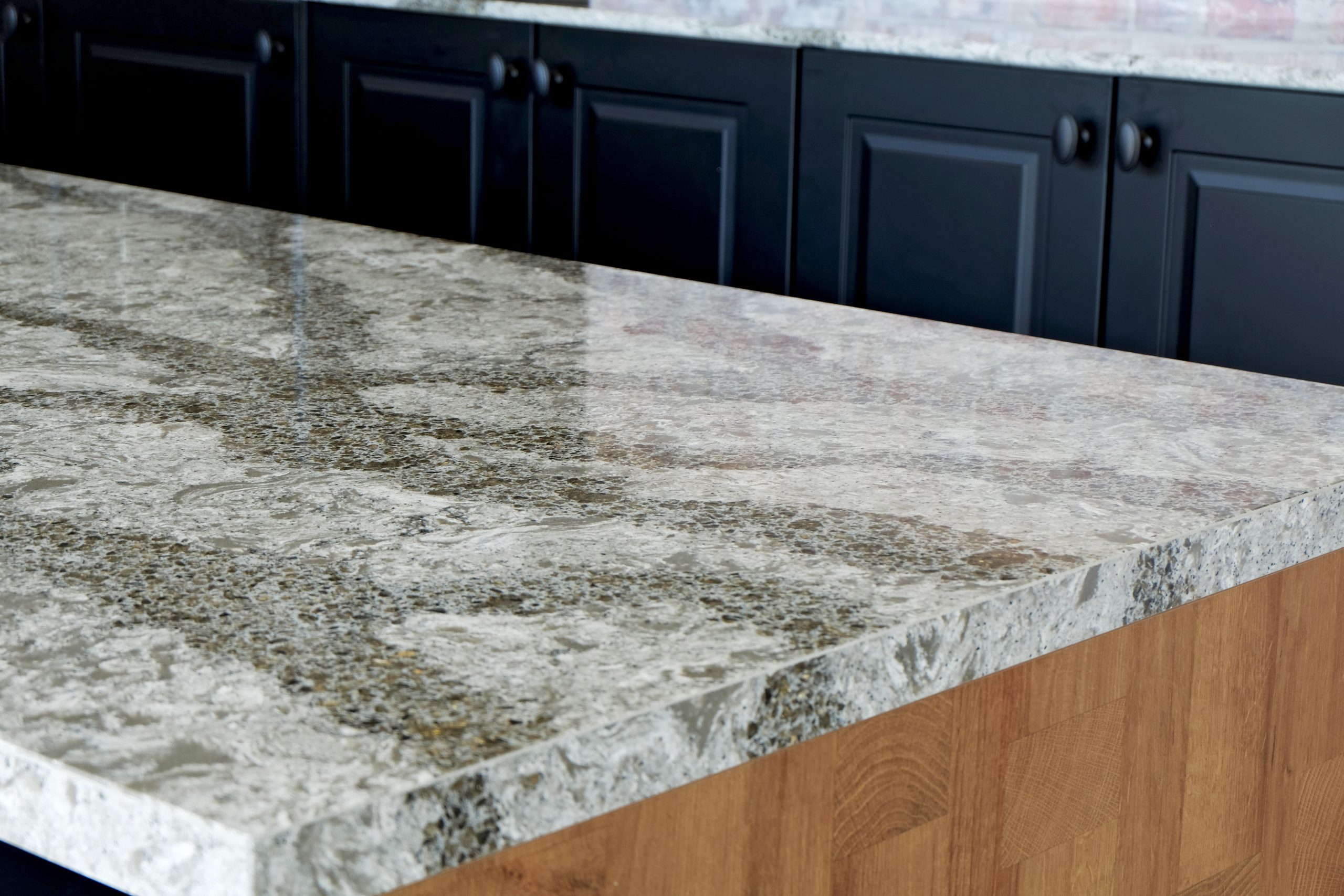
A correctly installed countertop should look like an integrated part of the kitchen or bathroom rather than a separate piece simply placed on top of the cabinets.
The surface should be stable, properly aligned, and supported. Countertop sections should meet cleanly, exposed edges should have a consistent finish, and the stone should fit appropriately against the walls and cabinets.
A properly installed countertop generally has:
- A level or appropriately aligned surface
- Secure support from the cabinetry
- Properly finished edges
- Cleanly joined seams
- Correct sink and appliance cutouts
- Consistent overhangs
- No unexplained movement
- No major gaps against walls
- No visible installation damage
The exact appearance will depend on the material, design, and room.
Granite, quartz, and marble can all be fabricated and installed professionally, but each material has different visual characteristics.
How Can You Tell If a Countertop Is Level?
One of the easiest things to check is whether the countertop appears level and sits consistently across the cabinets.
A professional installation should not have an obvious slope or uneven section unless the design specifically requires it.
You can check visually first. Look across the countertop from different angles and compare the surface with nearby cabinet lines, backsplash areas, and appliances.
For a more precise check, a small spirit level can help identify significant differences.
However, homeowners should avoid making adjustments themselves. If something appears significantly uneven, it is better to have the installer inspect it.
Should a Stone Countertop Move After Installation?
No. A properly installed stone countertop should feel stable under normal use.
It should not rock, shift, or noticeably move when you place normal pressure on it.
This is especially important with heavy materials such as granite and marble.
Quartz countertops are also heavy and require appropriate support and installation.
If you notice movement, do not assume that it is normal simply because the countertop is heavy. Movement can indicate an issue with support, cabinet condition, leveling, or installation.
How Should Countertops Sit on Cabinets?
The countertop should rest securely on the prepared cabinet structure with appropriate support.
The exact installation method depends on the material, cabinet configuration, countertop dimensions, and design.
Large islands and extended overhangs may require additional structural support.
This is particularly important when homeowners have:
- Large kitchen islands
- Breakfast bars
- Waterfall edges
- Deep overhangs
- Seating areas
- Long unsupported sections
A professional installer should determine where additional support is necessary rather than relying only on the cabinets.
How Do You Know If a Countertop Seam Was Installed Correctly?
A countertop seam should be properly aligned, securely joined, and as visually unobtrusive as reasonably possible.
A seam will not necessarily disappear completely. Natural stone and engineered quartz have different patterns, and lighting can make a seam more or less noticeable.
A good seam should generally have:
- Proper alignment
- Consistent height
- Minimal visible separation
- Clean adhesive work
- No significant raised or lowered section
- No obvious damage around the joint
Seam visibility can vary depending on the countertop material.
A relatively uniform quartz design such as a simple white surface may make a seam easier to see in certain lighting, while a more active granite pattern can visually break it up.
Why Are Some Countertop Seams More Visible Than Others?
Seam visibility depends on several factors, including material color, pattern, lighting, seam location, and fabrication quality.
A dramatic natural stone pattern can sometimes make a seam less noticeable because there is already considerable visual movement.
A plain white or light-colored surface can make even a carefully fabricated seam more visible.
For engineered quartz, brands such as Caesarstone, Cambria, and Silestone offer many designs with different levels of movement. These are examples of established quartz brands; availability varies by fabricator and project.
The quality of the fabrication and installation still matters regardless of the brand.
Should Countertop Edges Look Even?
Yes. Exposed countertop edges should have a consistent shape and finish.
If you selected an eased edge, for example, the edge should look consistent along the exposed sections.
A bullnose profile should have a smooth continuous curve.
More decorative profiles such as ogee edges require additional attention because irregularities can be easier to notice.
Look at the countertop from standing height as well as from close range.
The edge should not have obvious rough spots, unfinished areas, inconsistent polishing, or unexplained changes in shape.
How Should a Sink Cutout Look After Installation?
A sink cutout should fit the selected sink properly and provide a clean transition between the sink and countertop.
For an undermount sink, the stone edge around the opening should be smooth and consistently finished.
The sink should also be properly positioned and supported according to the installation requirements.
Check for:
- Even spacing around the sink
- Smooth stone edges
- Correct sink positioning
- No visible cracks
- No obvious gaps
- Secure installation
Granite Empire of Cincinnati’s current $1,999 granite countertop package includes up to 50 square feet, four granite color options, a free sink, and a free sink cutout.
How Should a Cooktop Cutout Look?
A cooktop cutout should correspond to the manufacturer’s required dimensions and installation specifications.
The appliance should fit without forcing it into the opening.
The stone around the cutout should be properly finished and free from obvious damage.
This is especially important around corners because poorly executed cuts can create weak areas.
If a cooktop or other appliance does not fit correctly, do not attempt to enlarge the opening yourself. A professional stone fabricator should evaluate the situation.
Should Countertops Touch the Wall?
Countertops are normally installed to fit closely against walls, but the exact appearance depends on the condition of the wall and the countertop design.
Older homes may have walls that are not perfectly straight.
Small variations can therefore occur.
The important question is whether the countertop was accurately fabricated for the actual space and whether any remaining gaps are appropriately addressed through the planned backsplash, caulk, or other finish.
A significant unexplained gap may indicate a measurement or installation problem and should be inspected.
How Much Overhang Should a Countertop Have?
Countertop overhang depends on the design and intended use.
A standard countertop overhang can be relatively modest, while a seating area may require a larger projection.
Large overhangs need appropriate support.
A correctly installed countertop should have consistent overhang dimensions where the design calls for them.
If one section of the countertop extends noticeably farther than another without a design reason, ask the installer to verify the measurements.
Can You Check Countertop Installation the Same Day?
Yes. A visual inspection can be performed immediately after installation.
However, some issues may become noticeable only after the kitchen is used normally.
On installation day, check:
- Surface alignment
- Stability
- Seams
- Edges
- Sink position
- Appliance openings
- Overhangs
- Visible chips or cracks
- Cabinet alignment
- Wall fit
Do not rush through the final inspection simply because the countertop looks attractive.
The installation details matter just as much as the stone’s appearance.
What Are the Most Common Countertop Installation Problems?
Common problems can involve fit, support, seams, leveling, or damage.
Potential issues include:
- Uneven countertop sections
- Poorly aligned seams
- Incorrect sink cutouts
- Excessive gaps
- Inconsistent overhangs
- Damaged edges
- Chipped corners
- Insufficient support
- Countertop movement
- Incorrect appliance openings
Not every visual difference means the countertop was installed incorrectly.
Natural stone contains variation, and every kitchen has its own construction conditions.
The key is to distinguish normal characteristics from actual installation defects.
How Much Does Professional Countertop Installation Cost?
Installation is often included in a complete countertop project, but pricing varies depending on the material, project size, fabrication requirements, and scope of work.
Granite Empire of Cincinnati currently lists starting prices of:
- Granite — $45 per square foot
- Quartz — $55 per square foot
- Marble — $55 per square foot
For a basic 50-square-foot project, the starting material calculations would be:
- Granite: approximately $2,250
- Quartz: approximately $2,750
- Marble: approximately $2,750
These are starting-price calculations, not guaranteed final project totals.
Custom edges, complicated layouts, additional cutouts, seams, selected materials, and other requirements can affect the final price.
What Is Included in Granite Empire of Cincinnati’s Granite Package?
The current granite package is $1,999 for up to 50 square feet.
It includes:
- Up to 50 square feet
- 4 granite color options
- Free sink
- Free sink cutout
This provides homeowners with a defined package option when planning a countertop project.
The exact availability and terms should be confirmed before ordering.
How Long Does Countertop Installation Take?
Granite Empire of Cincinnati lists installation timelines starting from approximately 5–7 business days for qualifying projects after final templating and approval.
The overall process can include:
Material selection → measurement → templating → fabrication → quality control → installation
The actual installation appointment may take several hours or longer depending on the size and complexity of the project.
A large kitchen with multiple countertop sections, a substantial island, several seams, or complicated cutouts may require more installation time than a small bathroom vanity.
What Should You Check Before the Installer Leaves?
Before the installation team leaves, look at the countertop from different angles and check the major functional areas.
Pay particular attention to:
- Countertop stability
- Surface alignment
- Seams
- Edges
- Sink cutout
- Faucet openings
- Cooktop opening
- Overhangs
- Cabinet support
- Visible damage
If you see something that concerns you, mention it immediately.
It is easier to document and address a concern while the installation team is still at the property.
How Can You Tell If Countertop Installation Quality Is Good?
Good installation is usually visible through small details rather than one dramatic feature.
The countertop should look proportional to the room, sit securely, and have clean transitions between different sections.
The sink and appliance openings should look intentional.
Edges should be smooth and consistent.
Seams should be carefully positioned and properly finished.
The countertop should also feel stable during normal use.
For homeowners comparing countertop installers in Covington, KY, these details can help distinguish professional installation from work that simply looks acceptable from a distance.
What Should You Do If Something Looks Wrong?
If you notice a significant issue, document it and contact the installer before attempting a repair.
Take clear photographs of:
- Seams
- Cracks
- Chips
- Gaps
- Uneven areas
- Sink cutouts
- Edges
- Overhangs
Avoid applying adhesives, grinding the stone, or attempting to adjust the countertop yourself.
Stone countertops are heavy and can be damaged if improperly handled.
A professional installer should evaluate the issue and determine whether it is related to the material, fabrication, cabinets, or installation.
Frequently Asked Questions About Countertop Installation
How do I know if my countertop was installed correctly?
Check that it is stable, properly aligned, appropriately supported, and correctly fitted around sinks, appliances, cabinets, and walls. Seams and edges should also be clean and properly finished.
Should a granite countertop move?
No. A properly installed granite countertop should remain stable under normal use.
Should a quartz countertop be perfectly level?
The countertop should be properly aligned and supported. Minor construction variations can exist, but noticeable unevenness should be evaluated by the installer.
Should countertop seams be invisible?
Not necessarily. A professional seam can still be visible, especially on light or highly uniform materials. The goal is a properly aligned, secure, and carefully finished seam.
How long does countertop installation take?
The overall timeline varies by project. Granite Empire of Cincinnati lists installation timelines starting from approximately 5–7 business days for qualifying projects after final templating and approval.
How much does granite cost?
Granite Empire of Cincinnati currently lists granite starting at $45 per square foot.
How much does quartz cost?
Quartz starts at $55 per square foot at Granite Empire of Cincinnati.
How much does marble cost?
Marble starts at $55 per square foot.
What is included in the $1,999 granite package?
The package includes up to 50 square feet, four granite color options, a free sink, and a free sink cutout.
What should I do if my countertop is damaged during installation?
Document the damage and contact the installer before attempting any repair. The company should determine whether the issue occurred during fabrication, transportation, or installation.
Granite Empire of Cincinnati: Stone Countertop Installation
Granite Empire of Cincinnati provides granite, quartz, marble, and other stone countertop fabrication and installation.
Address:
9474 Princeton Glendale Rd, OH 45011
Phone:
(513) 547-3711
Starting prices:
- Granite — $45/sq. ft.
- Quartz — $55/sq. ft.
- Marble — $55/sq. ft.
Granite Countertop Package — $1,999
- Up to 50 sq. ft.
- 4 granite color options
- Free sink
- Free sink cutout
Quartz Countertop Package — $3,000
- Up to 50 sq. ft.
- 4 quartz color options
- Free sink
- Free sink cutout
Installation timeline: Starting from approximately 5–7 business days for qualifying projects after final templating and approval.
For homeowners comparing countertop installers in Covington, KY, a successful installation is more than simply placing stone on top of cabinets. The finished countertop should be stable, properly supported, accurately fitted, cleanly joined, and professionally finished around sinks, appliances, walls, and exposed edges. A careful final inspection helps homeowners confirm that the finished project meets the expected standard before the installation is considered complete.