

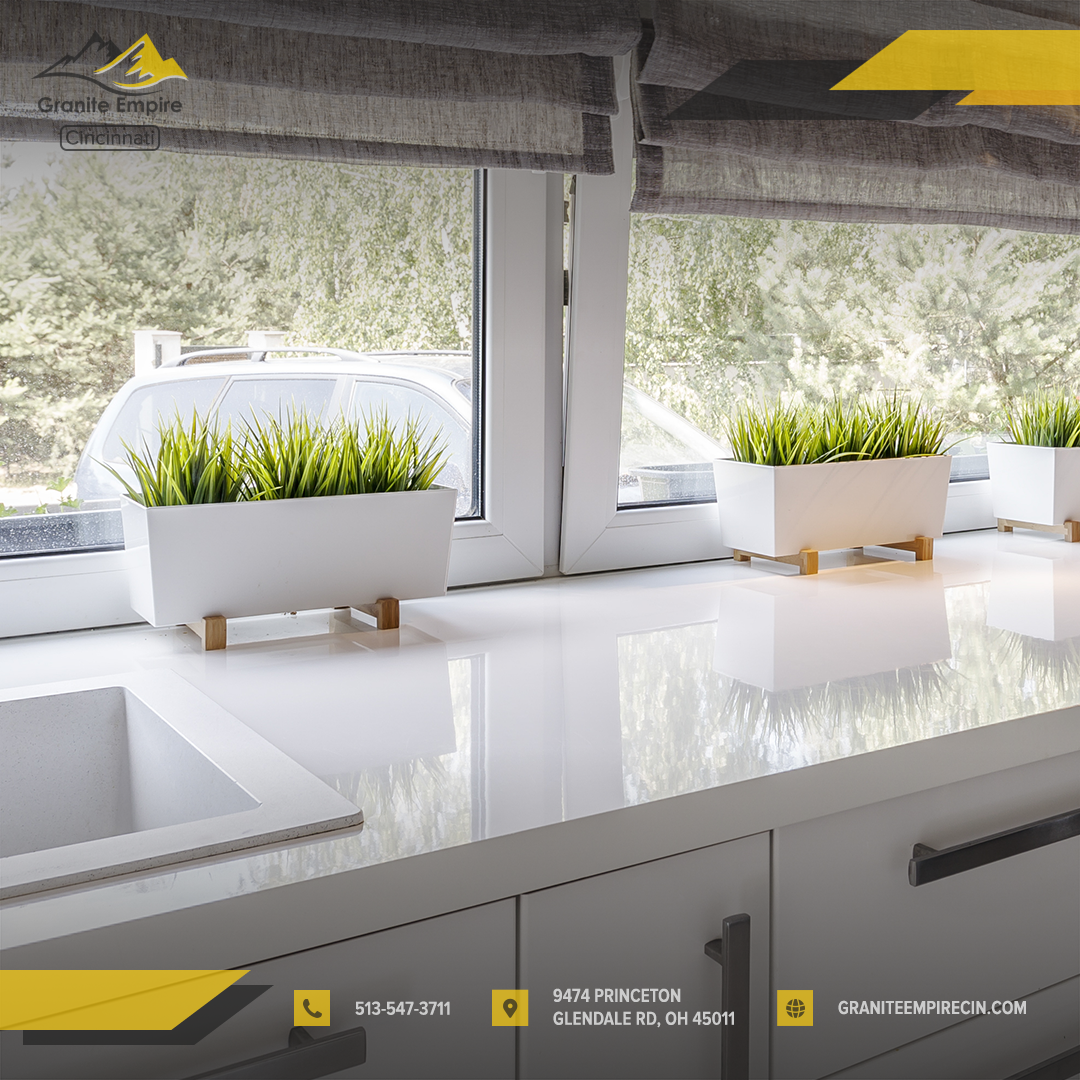
Quartz countertops are engineered surfaces made from crushed natural quartz minerals combined with resins, pigments, and other materials. The mixture is compressed into slabs, cured, polished, and fabricated into custom countertops for kitchens, bathrooms, islands, and other interior spaces.
Homeowners comparing quartz kitchen countertops in Springfield, OH often choose this material because it combines natural mineral content with consistent color, strong stain resistance, and low routine maintenance. Unlike granite or marble, quartz countertops are manufactured rather than cut directly from a single natural stone block.
Granite Empire of Cincinnati provides quartz countertop fabrication and installation for homeowners in Springfield, OH and surrounding Ohio communities. Quartz starts at $55 per square foot, and qualifying projects may be completed in approximately 5–7 business days after final templating and material approval.
Are Quartz Countertops Made from Real Quartz?
Yes, quartz countertops contain real quartz minerals. The natural quartz is crushed into particles or fine material and then combined with binders and pigments to create a solid engineered slab.
Quartz is one of the hardest common minerals. Its presence gives the finished countertop strength, durability, and resistance to everyday scratches.
A typical slab may contain:
- Crushed natural quartz
- Mineral aggregates
- Polymer or resin binders
- Color pigments
- Decorative particles
- Recycled glass in some designs
- Metallic or mirror-like accents in selected models
The exact formula varies by brand and product line. Some manufacturers use finer quartz particles for a smooth appearance, while others use larger chips to create more visible texture.
How Much Natural Quartz Is in a Quartz Countertop?
Most engineered quartz slabs contain a high percentage of mineral content, but the exact amount varies by manufacturer. The remaining material usually includes resin, pigments, and decorative additives.
Manufacturers may describe mineral content differently depending on whether they measure by weight or volume. For homeowners, performance and warranty information are often more useful than one percentage printed in marketing material.
The resin plays an important role because it binds the particles together. Without resin, the crushed quartz would not form a stable, nonporous countertop slab.
What Type of Resin Is Used in Quartz Countertops?
Quartz countertops commonly use polymer resins as the binding material. These resins help create a dense surface with low water absorption and strong resistance to many household stains.
The resin also gives engineered quartz some flexibility compared with brittle natural stone. However, it makes quartz less resistant to direct high heat than granite or quartzite.
Because resin can react to excessive heat, homeowners should use trivets beneath:
- Hot pans
- Dutch ovens
- Baking sheets
- Electric skillets
- Air fryers
- Slow cookers
- Countertop grills
Heat protection helps preserve the color and structural integrity of the surface.
How Are Quartz Countertop Colors and Patterns Created?
Quartz colors and patterns are created by adding pigments and arranging different mineral mixtures during manufacturing. This allows manufacturers to produce solid colors, small speckles, concrete-inspired finishes, and dramatic marble-look veining.
Popular design categories include:
- Bright white
- Warm white
- Soft gray
- Beige and cream
- Black
- Concrete look
- Carrara-inspired patterns
- Calacatta-style veining
- Statuario-style movement
- Terrazzo-inspired surfaces
Unlike natural granite or marble, quartz designs can be produced with greater consistency. This helps homeowners plan seams, islands, backsplashes, and multiple countertop sections with fewer unexpected color changes.
How Are Marble-Look Quartz Countertops Made?
Marble-look quartz is created by combining a light base with printed, poured, or layered veining. Manufacturers use different production methods to imitate Carrara, Calacatta, Statuario, and other natural marble styles.
The appearance can range from subtle gray lines to bold gold or charcoal movement. Premium products often have deeper, more varied veining than entry-level quartz.
Common style names include:
- Calacatta Gold
- Calacatta Laza
- Calacatta Leon
- Carrara Marmi
- Statuario
- Calacatta Miraggio
- Calacatta Arno
- Calacatta Classique
Product names and availability differ by brand. Homeowners should view a full slab or large sample because small chips may not show the complete vein pattern.
Which Quartz Brands Are Commonly Available?
Well-known quartz brands include Cambria, Caesarstone, Silestone by Cosentino, MSI Q Quartz, Viatera by LX Hausys, and Corian Quartz. Each brand offers different designs, warranties, slab sizes, finishes, and price levels.
A basic brand comparison may look like this:
| Quartz Brand | Known For | Common Design Style |
|---|---|---|
| Cambria | American-made collections and premium patterns | Marble-look and bold veining |
| Caesarstone | Wide design selection | Stone, concrete, and marble looks |
| Silestone | Broad color range and branded surface technology | Modern and classic patterns |
| MSI Q Quartz | Competitive pricing and large selection | Calacatta, Carrara, and neutral styles |
| Viatera | Detailed veining and refined finishes | Luxury marble-inspired designs |
| Corian Quartz | Consistent engineered surfaces | Neutral and contemporary patterns |
Brand name alone does not determine whether a slab is right for a kitchen. The best choice depends on color, finish, warranty, slab dimensions, maintenance expectations, and budget.
Are Quartz Countertops Completely Nonporous?
Quartz countertops are considered nonporous for normal residential use because the resin-bound surface absorbs very little liquid. They do not usually require routine sealing.
This makes quartz resistant to many common spills, including:
- Coffee
- Tea
- Juice
- Cooking oil
- Tomato sauce
- Makeup
- Soap
- Toothpaste
Spills should still be cleaned promptly. Pigmented liquids, harsh chemicals, and dried residue may become more difficult to remove if left on the surface.
For homeowners choosing quartz kitchen countertops in Springfield, OH, low porosity is one of the main advantages over many natural stone options.
Do Quartz Countertops Need to Be Sealed?
No, engineered quartz countertops normally do not need sealing. The manufacturing process creates a dense surface that does not absorb liquids like unsealed marble or some granite varieties.
Applying natural stone sealer to quartz may leave a film or uneven finish. Homeowners should follow the care instructions provided by the specific manufacturer.
Routine maintenance generally requires:
- Warm water
- Mild dish soap
- Soft microfiber cloths
- Nonabrasive surface cleaner
- Prompt spill cleanup
A plastic scraper can sometimes remove dried food residue without scratching the surface. Metal blades and abrasive pads should be avoided.
Are Quartz Countertops the Same as Quartzite?
No, quartz and quartzite are different materials. Quartz countertops are engineered, while quartzite is a natural stone quarried in large blocks and cut into slabs.
| Feature | Quartz | Quartzite |
|---|---|---|
| Material type | Engineered surface | Natural stone |
| Composition | Quartz particles, resin, pigments | Metamorphic natural stone |
| Sealing | Usually not required | Usually required |
| Pattern consistency | More predictable | Naturally variable |
| Heat resistance | Moderate | High |
| Maintenance | Low | Moderate |
| Appearance | Manufactured designs | Unique natural movement |
Quartzite usually offers stronger heat resistance, but it may cost more and require periodic sealing. Quartz offers easier maintenance and more consistent colors.
Are Quartz Countertops the Same as Granite?
No, granite is a natural stone, while quartz is manufactured from mineral particles and resin. Granite slabs are quarried, cut, polished, and fabricated without being remade into an engineered mixture.
Granite offers:
- Natural pattern variation
- Strong heat resistance
- Unique slabs
- Periodic sealing in many cases
Quartz offers:
- Consistent designs
- Low porosity
- No routine sealing
- Strong stain resistance
- Large selection of marble-look patterns
Neither material is automatically better. The decision depends on cooking habits, design preference, maintenance expectations, and budget.
How Durable Are Quartz Countertops?
Quartz countertops are highly durable for daily kitchen use. They resist many stains, scratches, and impacts, but they are not completely damage-proof.
Potential risks include:
- Heat discoloration
- Chips along exposed edges
- Cracks near unsupported cutouts
- Damage from heavy impact
- Chemical discoloration
- UV fading in prolonged direct sunlight
Quartz should be professionally fabricated and installed. Proper support around sinks, cooktops, seams, and large overhangs helps prevent stress damage.
Can Quartz Countertops Scratch?
Quartz is scratch resistant, but it can still be damaged by sharp objects or abrasive materials. Cutting boards should be used during food preparation.
Direct cutting may also dull kitchen knives. Ceramic dishes, rough-bottomed cookware, and metal objects can leave marks if dragged across the surface.
The safest habits are simple:
- Use cutting boards
- Lift heavy cookware
- Avoid abrasive pads
- Clean grit before wiping
- Protect high-use preparation areas
These habits help maintain the original finish for many years.
Can Quartz Countertops Handle Hot Pans?
Quartz can tolerate normal kitchen temperatures, but direct contact with very hot cookware should be avoided. The resin in the surface can discolor or become damaged under excessive heat.
Always use:
- Trivets
- Heat-resistant pads
- Cutting boards
- Appliance mats
Long-term heat from slow cookers, toaster ovens, and electric griddles can also affect the surface. Protective pads are useful even when the appliance does not appear extremely hot.
Are Quartz Countertops Safe for Food Preparation?
Yes, quartz is well suited for food preparation because it has a smooth, low-porosity surface. Routine cleaning helps keep it sanitary.
However, raw meat, fish, and poultry should still be prepared on cutting boards. This protects both the countertop and the food preparation process.
Homeowners should avoid using harsh industrial disinfectants unless approved by the quartz manufacturer. Mild soap and water are suitable for most daily cleaning.
How Much Do Quartz Countertops Cost?
Quartz at Granite Empire of Cincinnati starts at $55 per square foot. A complete kitchen project commonly ranges from approximately $3,000 to $8,000 or more, depending on size, color, brand, fabrication, edges, and installation complexity.
The price may increase for:
- Premium quartz brands
- Dramatic Calacatta patterns
- Extra-thick or mitered edges
- Waterfall island panels
- Full-height backsplashes
- Multiple sink or cooktop cutouts
- Large islands
- Difficult delivery access
- Removal of existing countertops
A written estimate should explain which services are included. Material price alone does not show the complete installed cost.
What Is Included in the Quartz Countertop Package?

Granite Empire of Cincinnati offers a $3,000 quartz countertop package for qualifying projects. The package includes up to 50 square feet, four selected colors, a free sink, and a free sink cutout.
The package includes:
- Quartz countertop material
- Up to 50 square feet
- Four selected color options
- Free sink
- Free sink cutout
Additional costs may apply for extra square footage, decorative edges, cooktop cutouts, old countertop removal, plumbing, backsplash pieces, or specialty fabrication.
For many standard kitchens, package pricing makes budgeting easier because several major project elements are grouped into one offer.
How Does Quartz Pricing Compare with Other Materials?
Quartz is often priced above entry-level granite but below some premium marble and quartzite projects. The final comparison depends on the exact slab and installation details.
| Material | Typical Starting Point | Maintenance Level | Main Cost Factor |
|---|---|---|---|
| Granite | Often lower than quartz | Moderate | Natural color and slab category |
| Quartz | From $55/sq. ft. | Low | Brand and design |
| Marble | Often similar or higher | High | Rarity and veining |
| Quartzite | Usually premium | Moderate | Hard fabrication and slab rarity |
| Laminate | Lower | Low | Product grade and edge style |
The most affordable choice is not always the best long-term value. Durability, cleaning requirements, replacement risk, and resale appeal should also be considered.
How Are Quartz Countertops Fabricated?
Quartz slabs are measured, cut, shaped, polished, and prepared for installation in a fabrication shop. The process begins after cabinets are fully installed, level, and secured.
Fabrication typically includes:
- Digital templating
- Slab layout planning
- Cutting countertop sections
- Creating sink openings
- Creating cooktop openings
- Shaping edge profiles
- Polishing exposed edges
- Preparing seams
- Final quality inspection
The slab pattern must be planned before cutting, especially for large Calacatta-style veins. Good layout planning helps the movement continue naturally across seams and corners.
How Long Does Quartz Fabrication and Installation Take?
Qualifying quartz projects may be completed in approximately 5–7 business days after final templating and approval. Complex projects or special-order colors may require two to three weeks.
A typical timeline is:
| Project Stage | Typical Time |
|---|---|
| Consultation and estimate | 1–2 days |
| Material selection | 1–3 days |
| Digital templating | 1–3 hours |
| Fabrication | 3–6 business days |
| Installation | 4–8 hours |
| Sink adhesive curing | 12–24 hours |
Changes to the sink, faucet, cooktop, or cabinet layout after templating may delay the project. Final decisions should be made before fabrication begins.
Granite Empire of Cincinnati provides both fabrication and installation for quartz kitchen countertops in Springfield, OH, helping reduce scheduling gaps between separate contractors.
Which Edge Profiles Work Best with Quartz?
Quartz can be fabricated with both simple and decorative edge profiles. A standard eased edge is usually the most affordable and easiest to maintain.
Common options include:
- Eased edge
- Beveled edge
- Half bullnose
- Full bullnose
- Ogee edge
- Mitered edge
- Waterfall edge
Mitered edges create the appearance of a thicker countertop but require additional material and fabrication. Decorative edges may also increase the final project cost.
The edge should match the kitchen style without creating unnecessary maintenance or expense.
How Should Quartz Countertop Seams Look?
Quartz seams should be tight, level, stable, and planned around the surface pattern. The adhesive should coordinate with the base color.
A high-quality seam should have:
- Minimal width
- No sharp height difference
- Clean adhesive
- Stable support
- Logical vein alignment
- No movement under pressure
Some seams will remain visible, particularly in solid white or heavily veined quartz. Professional planning helps reduce their visual impact.
Can Quartz Be Used for Waterfall Islands?
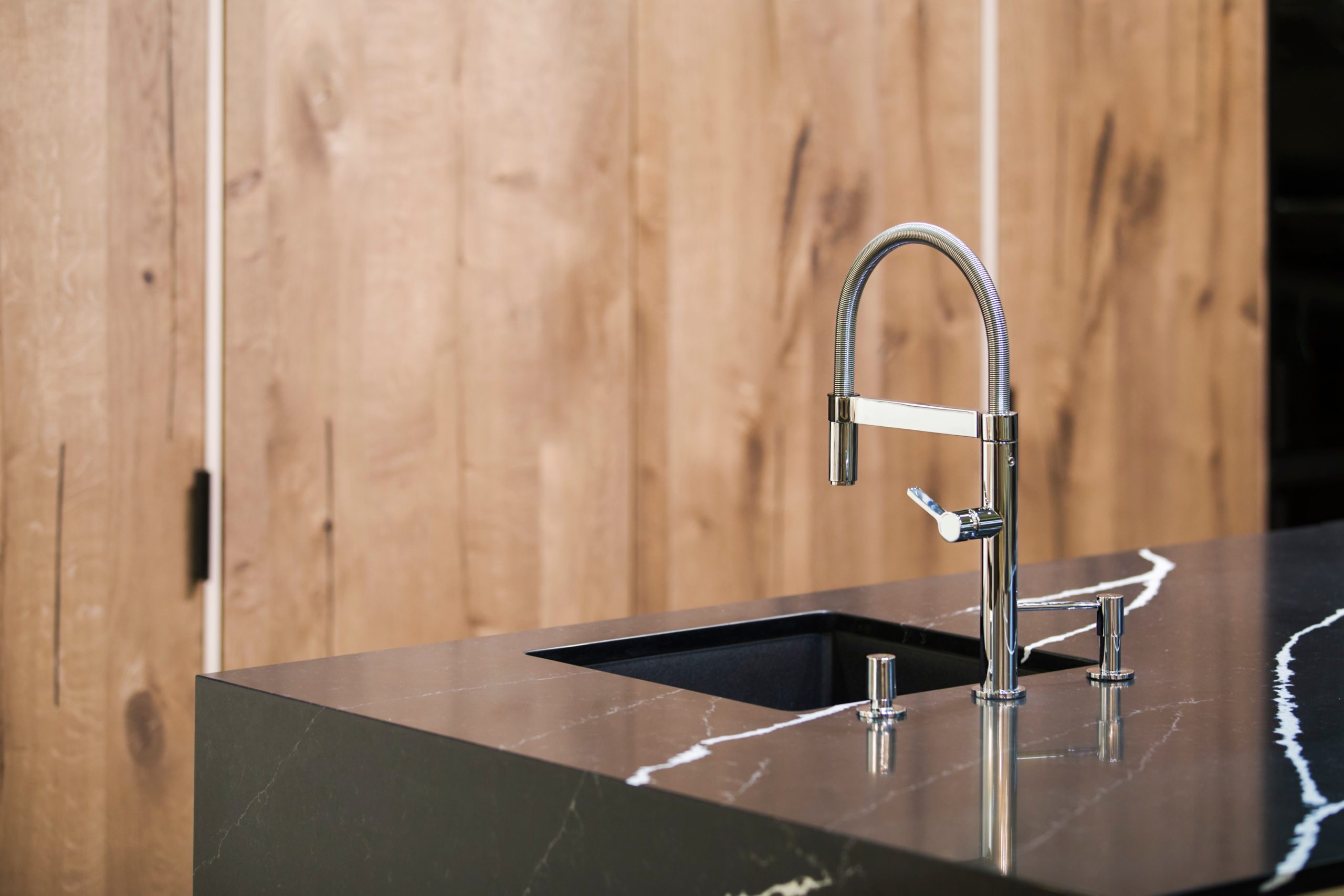
Yes, quartz is commonly used for waterfall islands because the consistent design can continue from the horizontal surface down the side panel. Strong vein planning is especially important with dramatic patterns.
Waterfall fabrication may increase cost because it requires:
- Additional slab material
- Mitered joints
- Precise vein matching
- More transportation care
- Additional installation labor
The island structure must also be level and secure before templating.
What Quartz Designs Work Best with White Cabinets?
White cabinets work with a wide range of quartz designs. The best choice depends on whether the homeowner wants subtle contrast or a bold focal point.
Popular combinations include:
- White quartz with soft gray veins
- Warm white quartz with gold movement
- Concrete-gray quartz
- Black quartz
- Beige quartz with subtle texture
- Calacatta-inspired quartz
Warm-veined quartz often complements brass hardware and natural wood accents. Cooler gray veining works well with chrome, stainless steel, and blue-gray cabinets.
What Quartz Designs Work Best with Wood Cabinets?
Wood cabinets pair well with warm white, beige, cream, taupe, and softly veined quartz. The surface should balance the cabinet grain rather than compete with it.
For oak, maple, walnut, or cherry cabinets, consider:
- Cream quartz
- Warm Calacatta patterns
- Soft beige quartz
- Subtle Carrara styles
- Light concrete-look quartz
- White quartz with fine gold veining
Large samples should be viewed next to cabinet doors and flooring under the home’s actual lighting.
What Questions Should You Ask Before Buying Quartz?
You should ask about the brand, design, warranty, heat limits, slab dimensions, fabrication, and included installation services. These details affect both performance and total cost.
Ask the countertop company:
- Who manufactures the quartz?
- What is the product name?
- Is the color in stock?
- What warranty is included?
- Is fabrication included?
- Is installation included?
- Which edge profile is standard?
- Are sink cutouts included?
- Where will seams be placed?
- How should the surface be cleaned?
- How long will the project take?
- What is the complete installed price?
Homeowners comparing quartz kitchen countertops in Springfield, OH should request a written estimate based on real measurements rather than relying only on a price per square foot.
What Are the Most Common Questions About Quartz Countertops?
Are quartz countertops made entirely from natural quartz?
No. They contain natural quartz minerals combined with resin, pigments, and other materials.
Is quartz considered natural stone?
Quartz countertops are engineered surfaces. They contain natural minerals but are manufactured into slabs.
Do quartz countertops need sealing?
No. Engineered quartz normally does not require routine sealing.
Can quartz countertops stain?
Quartz resists many stains, but spills and chemicals should still be cleaned promptly.
Can hot pans damage quartz?
Yes. Excessive heat can affect the resin, so trivets should be used.
Is quartz harder than granite?
Quartz is highly durable, but hardness alone does not determine performance. Granite generally offers stronger heat resistance.
How long do quartz countertops last?
Properly fabricated and maintained quartz countertops can last for decades.
How quickly can quartz countertops be installed?
Qualifying Granite Empire of Cincinnati projects may be completed in approximately 5–7 business days after final templating and approval.
Are Quartz Countertops Right for Springfield Homeowners?
Quartz is a strong choice for Springfield, OH homeowners who want low maintenance, predictable colors, and strong resistance to everyday stains. It is especially practical for busy kitchens, bathroom vanities, islands, and family gathering spaces.
The material offers more design consistency than granite or marble while still containing real quartz minerals. Its main limitations are lower heat resistance and the possibility of visible seams or chips along exposed edges.
Granite Empire of Cincinnati helps homeowners compare brands, colors, patterns, edge profiles, and installation options. The company provides custom fabrication and professional installation for quartz, granite, marble, and other stone surfaces.
How Can You Contact Granite Empire of Cincinnati?
Granite Empire of Cincinnati
Address: 9474 Princeton Glendale Rd, OH 45011
Phone: (513) 547-3711
Services:
- Quartz countertop fabrication
- Quartz countertop installation
- Granite countertop fabrication and installation
- Marble countertop fabrication and installation
- Digital templating
- Sink and cooktop cutouts
- Kitchen islands
- Bathroom vanity tops
- Countertop replacement
Quartz starting price: From $55 per square foot
Quartz countertop package:
- $3,000
- Up to 50 square feet
- Four selected colors
- Free sink
- Free sink cutout
Qualifying installation timeline: Starting from 5–7 business days
Granite Empire of Cincinnati serves homeowners in Springfield, OH with quartz selection, digital templating, custom fabrication, edge finishing, seam planning, delivery, and professional installation. Contact the team for a detailed estimate based on the kitchen size, selected quartz brand and model, edge profile, sink, cutouts, and project layout.