

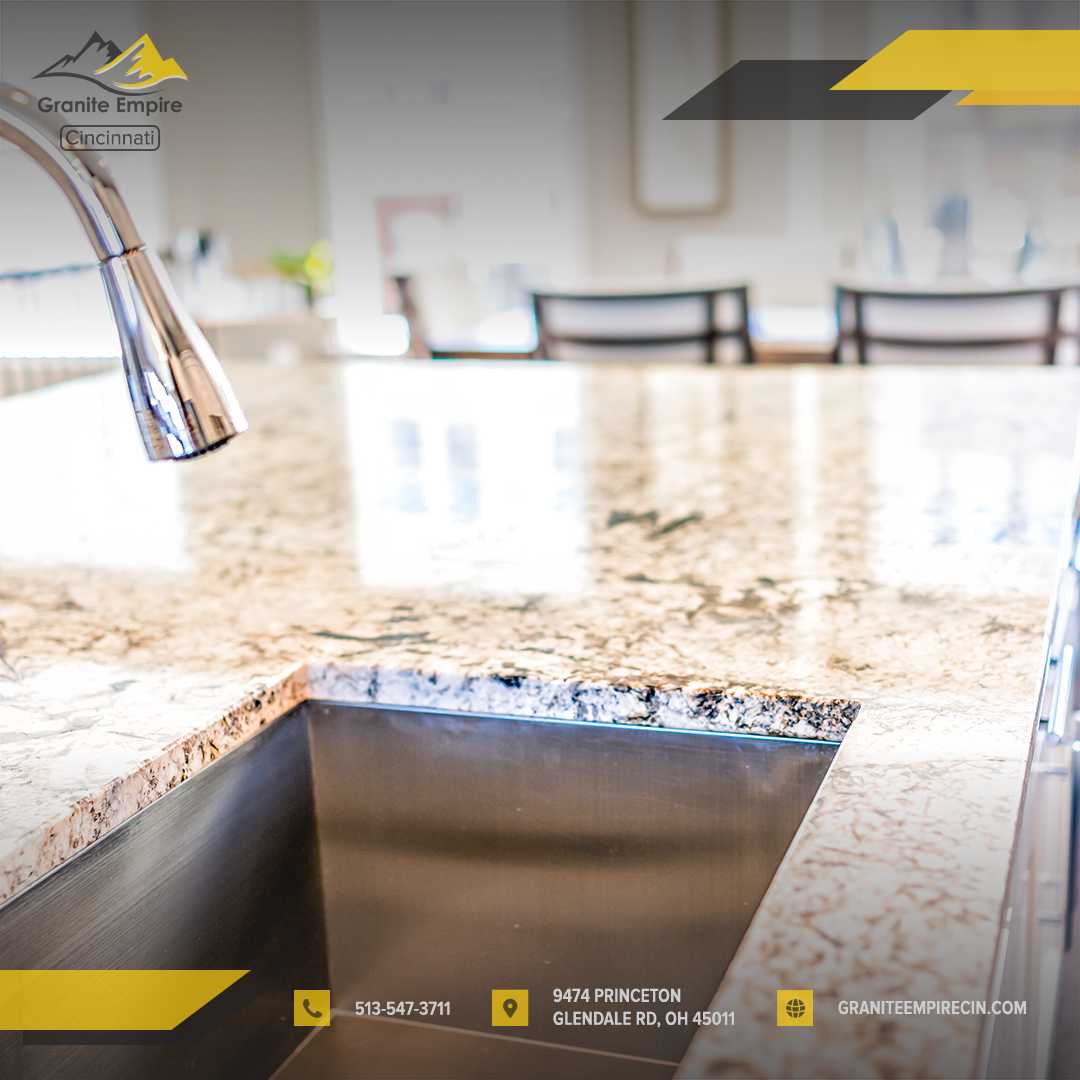
No, granite countertops are not all the same quality. The final result depends on the stone itself, the slab grade, thickness, structural condition, polish, fabrication accuracy, seam placement, and installation quality.
Two granite slabs may look similar in a showroom but perform differently after installation. Homeowners comparing granite kitchen countertops in Springfield, OH should evaluate the full slab, not just a small sample or the price per square foot.
Granite Empire of Cincinnati provides granite countertop selection, fabrication, and professional installation for homeowners in Springfield, OH and surrounding areas. Granite prices start at $45 per square foot, and qualifying projects may be completed in approximately 5–7 business days.
What Determines the Quality of a Granite Countertop?

Granite quality is determined by both the natural slab and the workmanship used to turn it into a finished countertop. A premium slab can still produce a poor result if it is measured, cut, polished, or installed incorrectly.
The main quality factors include:
- Slab density and structural condition
- Thickness
- Color and pattern consistency
- Surface polish
- Amount of filler or resin
- Accuracy of fabrication
- Edge quality
- Cutout quality
- Seam placement
- Installation support
The best countertop projects combine a sound slab with precise fabrication and careful installation.
Are There Different Grades of Granite?
Yes, granite is often grouped into entry-level, mid-range, and premium categories. These categories usually reflect availability, color rarity, pattern movement, origin, slab thickness, and processing rather than a universal industry grading standard.
A practical comparison looks like this:
| Granite Category | Typical Characteristics | General Price Level | Best For |
| Entry-level | Common colors, consistent pattern, broad availability | Lower | Budget-focused kitchens |
| Mid-range | More movement, richer color variation, less common patterns | Moderate | Custom kitchens |
| Premium | Rare colors, dramatic veining, exotic movement | Higher | Luxury kitchens and statement islands |
Entry-level granite is not automatically poor quality. A common, widely available color can be strong, durable, and attractive when it is properly fabricated.
Premium granite usually costs more because of appearance and availability, not necessarily because it is dramatically stronger.
Does Granite Price Always Reflect Quality?
No, a higher price does not always mean better structural quality. Price is often influenced by rarity, transportation, quarry location, slab size, pattern, and market demand.
For example, a durable black or speckled granite may cost less than a dramatic white slab with flowing movement. The more expensive option may be visually rarer, but both can perform well in a kitchen.
Granite Empire of Cincinnati offers granite starting at $45 per square foot. The final price may increase based on:
- Premium slab selection
- Total square footage
- Decorative edges
- Multiple cutouts
- Number of seams
- Waterfall panels
- Full-height backsplashes
- Removal of old countertops
- Difficult installation access
Customers should compare the complete installed quote rather than judging the stone only by its slab price.
How Can You Tell If a Granite Slab Is Good Quality?
A good-quality granite slab should have a consistent finish, stable structure, and no obvious damage that could weaken the finished countertop. Natural variation is expected, but excessive cracking, poor repair work, or uneven polishing should be reviewed carefully.
Look for:
- A smooth, even polish
- No large open cracks
- No loose sections
- Consistent slab thickness
- Clean edges
- Limited visible resin patches
- Stable natural fissures
- No deep scratches
- No dull or cloudy areas
Some fissures are natural features rather than defects. A professional fabricator should explain whether a line is a harmless mineral characteristic or a structural concern.
Are Fissures in Granite a Sign of Poor Quality?
Not always. Fissures are naturally occurring lines formed during the development of the stone, and many granite slabs contain them.
A fissure usually does not separate the stone into two unstable sections. A crack, however, may create movement or structural weakness.
The difference can often be identified by:
- Whether the line catches a fingernail
- Whether the stone moves along the line
- Whether the line extends through the slab
- Whether filler has been used
- Whether the area is near a sink or cooktop opening
Fissures can be part of the natural appearance of granite. Large cracks or heavily repaired areas require more careful evaluation.
Does Granite Thickness Affect Quality?
Yes, granite thickness affects strength, edge options, support needs, and overall appearance. Thicker slabs generally feel more substantial and may require less additional backing.
Common granite thicknesses include:
- Approximately 2 centimeters
- Approximately 3 centimeters
Three-centimeter granite is widely used for kitchen countertops because it offers strong structural performance and a substantial profile. Two-centimeter granite may require plywood support or a laminated edge, depending on the project.
Thickness should be consistent across the slab. Uneven thickness can create installation problems or require additional adjustment.
Does the Country of Origin Determine Granite Quality?
No, country of origin alone does not determine quality. Granite is quarried in many countries, including Brazil, India, Italy, Spain, China, and the United States.
Each region produces different colors, mineral structures, and patterns. Quality depends more on the individual slab, quarry conditions, processing, handling, and fabrication.
A properly processed common granite can outperform a poorly handled exotic slab. Homeowners should evaluate the actual material rather than relying only on the name of the country.
Are Some Granite Colors More Durable Than Others?
Yes, mineral composition and density can vary between granite colors. Darker, denser stones are often less absorbent, while some lighter materials may require more frequent sealing.
Popular granite colors include:
- Dallas White
- Luna Pearl
- Ubatuba
- Giallo Ornamental
- Azul Platino
- Colonial White
- Steel Gray
- Black Pearl
- New Venetian Gold
- White Ice
Ubatuba and Black Pearl are typically dense, dark options with strong stain resistance. Lighter stones such as Colonial White or Dallas White may need more attention to sealing because spills can be easier to notice.
Color alone does not determine whether a slab is suitable. The exact slab should still be inspected.
Is Entry-Level Granite Lower Quality?
No, entry-level granite is usually more affordable because it is widely available and easier to source. It can still provide excellent durability, heat resistance, and long-term value.
Entry-level colors often have:
- Smaller repeating mineral patterns
- High availability
- Easier slab matching
- Lower transportation costs
- Predictable fabrication
For many homeowners, these characteristics are advantages. A consistent pattern can make seams easier to blend and replacement pieces easier to source.
Granite Empire of Cincinnati offers a granite countertop package for $1,999 that includes up to 50 square feet, four selected colors, a free sink, and a free sink cutout. This package can provide strong value without reducing the importance of professional fabrication and installation.
How Important Is Granite Fabrication Quality?
Fabrication quality is just as important as slab quality. Even a beautiful slab can look disappointing if the cuts are inaccurate, the edges are uneven, or the seams are poorly planned.
Professional fabrication includes:
- Digital templating
- Slab layout planning
- Precise cutting
- Sink and cooktop cutouts
- Edge shaping
- Surface and edge polishing
- Seam preparation
- Final quality inspection
The fabricator must also decide where the strongest parts of the slab should be placed. Areas around sinks, cooktops, corners, and narrow countertop sections require careful planning.
What Should High-Quality Granite Edges Look Like?
High-quality granite edges should be smooth, evenly polished, and consistent from one section to another. The edge should not have chips, rough spots, flat areas, or cloudy polishing.
Common granite edge profiles include:
- Eased edge
- Beveled edge
- Half bullnose
- Full bullnose
- Ogee edge
- Mitered edge
A standard eased edge is usually the most affordable. Ogee and mitered profiles require more labor and may increase the fabrication cost.
The edge polish should closely match the finish on the top surface.
How Should Granite Seams Look?
Granite seams should be tight, level, stable, and placed where they are least visible. The pattern should be aligned as carefully as possible.
A good seam should have:
- Minimal width
- No sharp height difference
- Color-matched adhesive
- Stable support underneath
- Clean pattern transition
- No movement under pressure
Natural stone cannot always be matched perfectly. Dramatic veins and large mineral movement may make a seam more visible.
Experienced fabricators plan seam locations before cutting the slab. Homeowners choosing granite kitchen countertops in Springfield, OH should ask where the seams will be placed before approving fabrication.
How Can You Tell If a Sink Cutout Is Well Made?
A well-made sink cutout should be smooth, accurately sized, and positioned correctly within the sink cabinet. The reveal around an undermount sink should be consistent.
Check for:
- Smooth polished edges
- No chips near the corners
- Consistent sink reveal
- Proper faucet spacing
- Enough stone between the sink and countertop edge
- Secure sink support
Poorly shaped inside corners can create stress points. Professional fabrication uses the correct corner radius and reinforcement methods.
The free sink and cutout included in the Granite Empire of Cincinnati package can simplify both budgeting and project planning for qualifying kitchens.
Does Sealing Affect Granite Quality?

Sealing does not change the structural quality of granite, but it improves stain resistance in more absorbent stones. A properly sealed countertop is easier to maintain.
Granite sealing frequency depends on:
- Stone density
- Color
- Porosity
- Type of sealer
- Cleaning habits
- Amount of daily use
Some granite may need sealing every one to three years. Dense varieties may need it less often.
A simple water test can help. If water darkens the stone within several minutes, the surface may need sealing.
Can Granite Countertops Stain or Scratch?
Granite is highly durable, but it is not completely damage-proof. Unsealed or porous granite can absorb oils, wine, coffee, and dark liquids.
Granite is also scratch resistant, but repeated cutting directly on the surface can dull knives and may affect the finish over time.
Use:
- Cutting boards
- Trivets
- Mild cleaners
- Soft cloths
- pH-neutral stone products
Avoid harsh acids, abrasive powders, and repeated impact near edges or cutouts.
How Does Granite Compare with Quartz and Marble?
Granite offers stronger heat resistance than quartz and lower maintenance risk than marble. Quartz is easier to maintain, while marble provides a softer and more luxurious natural appearance.
| Material | Main Strength | Main Limitation | Starting Price |
| Granite | Heat resistance and natural variation | May require sealing | $45/sq. ft. |
| Quartz | Low maintenance and consistent pattern | Lower heat resistance | Often higher than entry-level granite |
| Marble | Elegant natural veining | Can etch and stain | Often higher depending on slab |
| Quartzite | Strong natural stone with dramatic movement | Higher fabrication cost | Usually premium |
Granite is often the best value for homeowners who want real stone, strong heat resistance, and a long service life.
How Much Should Quality Granite Countertops Cost?
A complete granite countertop project may cost approximately $2,000 to $7,000 or more. The total depends on the kitchen size, slab selection, edge profile, cutouts, removal work, and installation complexity.
Granite Empire of Cincinnati starts granite pricing at $45 per square foot. The current $1,999 package includes:
- Up to 50 square feet
- Four selected granite colors
- Free sink
- Free sink cutout
Additional costs may apply for:
- Extra square footage
- Premium slabs
- Decorative edges
- Cooktop cutouts
- Waterfall panels
- Full-height backsplash
- Old countertop removal
- Plumbing
- Cabinet correction
A detailed written estimate should identify all included services.
How Long Does Granite Fabrication and Installation Take?
Qualifying granite projects may be completed in approximately 5–7 business days after templating and material approval. More complex projects may take two to three weeks.
A typical schedule includes:
| Project Stage | Typical Time |
| Consultation and estimate | 1–2 days |
| Slab selection | 1–3 days |
| Digital templating | 1–3 hours |
| Fabrication | 3–6 business days |
| Installation | 4–8 hours |
| Sink adhesive curing | 12–24 hours |
Special-order slabs, unusual edge profiles, complex islands, cabinet repairs, or multiple seams can extend the timeline.
Granite Empire of Cincinnati handles both fabrication and installation, helping reduce delays between separate contractors.
How Can You Compare Granite Slabs Before Buying?
You should compare full slabs whenever possible because small samples do not show the complete pattern. Natural granite can vary significantly from one section to another.
Compare:
- Overall movement
- Color consistency
- Fissures
- Filled areas
- Surface polish
- Slab size
- Thickness
- Pattern direction
- Availability of matching slabs
For kitchens requiring more than one slab, inspect the slabs together. They should coordinate closely enough to create a balanced final design.
What Questions Should You Ask a Granite Countertop Company?
You should ask about the slab, fabrication process, included services, and installation responsibility. Clear answers help prevent unexpected costs and quality problems.
Ask:
- Is this the exact slab I will receive?
- What thickness is the granite?
- Does the stone need sealing?
- Where will the seams be placed?
- Is templating included?
- Is fabrication included?
- Is installation included?
- What edge profile is standard?
- Are sink and cooktop cutouts included?
- Is old countertop removal included?
- How long will the project take?
- Is there a workmanship warranty?
Homeowners shopping for granite kitchen countertops in Springfield, OH should compare written estimates using the same measurements, edge profiles, and cutout requirements.
What Are the Most Common Questions About Granite Quality?
Is expensive granite always better?
No. Expensive granite is often rarer or more visually dramatic, but a lower-priced slab can be equally durable.
Are natural fissures defects?
Usually not. Fissures are natural mineral features, while structural cracks may require repair or slab rejection.
Does dark granite need sealing?
Some dark, dense granites need little sealing, but the exact slab should still be tested.
Is 3-centimeter granite better than 2-centimeter granite?
Three-centimeter granite is generally stronger and often needs less support. Two-centimeter granite may still work well when properly reinforced.
Can low-cost granite last for decades?
Yes. Properly fabricated and installed granite can last for decades regardless of whether it is an entry-level or premium color.
How do I know if the polish is good?
The surface should reflect light evenly without cloudy areas, deep scratches, or dull spots.
Is granite better than quartz?
Granite offers natural variation and better heat resistance. Quartz offers lower maintenance and more consistent patterns.
How quickly can granite be installed?
Qualifying Granite Empire of Cincinnati projects may be completed in approximately 5–7 business days after final templating and approval.
Which Granite Is Best for Springfield Homeowners?
The best granite is a structurally sound slab that fits the homeowner’s budget, design, and maintenance expectations. A common granite color can be a better choice than an exotic slab if it offers the right appearance and stronger value.
Springfield, OH homeowners should focus on the complete project. Slab selection, templating, fabrication, edge polishing, cutouts, delivery, and installation all affect the final result.
Granite Empire of Cincinnati helps customers compare granite colors, understand natural features, choose edge profiles, and plan seams. The company provides professional fabrication and installation for granite kitchen countertops in Springfield, OH, with starting prices at $45 per square foot.
How Can You Contact Granite Empire of Cincinnati?
Granite Empire of Cincinnati
Address: 9474 Princeton Glendale Rd, OH 45011
Phone: (513) 547-3711
Services:
- Granite countertop fabrication
- Granite countertop installation
- Quartz countertop fabrication and installation
- Marble countertop fabrication and installation
- Sink and cooktop cutouts
- Kitchen islands
- Bathroom vanity tops
- Stone countertop replacement
Granite starting price: From $45 per square foot
Granite countertop package:
- $1,999
- Up to 50 square feet
- Four selected colors
- Free sink
- Free sink cutout
Qualifying installation timeline: Starting from 5–7 business days
Granite Empire of Cincinnati serves homeowners in Springfield, OH with slab selection, digital templating, custom fabrication, edge finishing, sink preparation, delivery, and professional installation. Contact the team for a detailed estimate based on the kitchen size, selected granite, edge profile, cutouts, and installation requirements.