

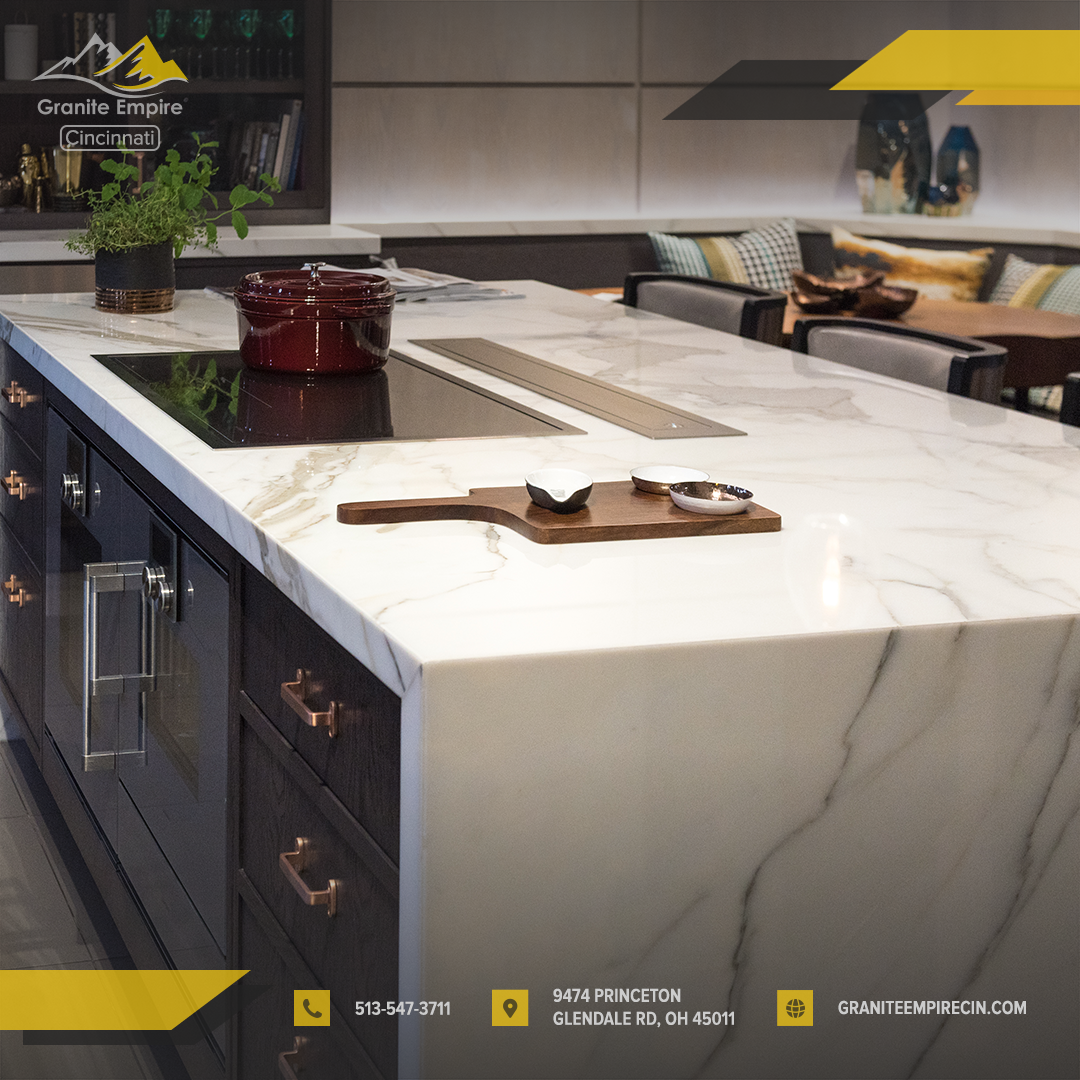
Marble and quartzite look similar but perform very differently. Marble is a softer, more porous stone that’s easier to fabricate and more affordable, but requires regular sealing and is vulnerable to etching. Quartzite is a much harder natural stone that resists etching and scratching far better than marble, but typically costs more and is more difficult to fabricate. For homeowners comparing marble countertops in Kettering, OH, the right choice depends on whether you prioritize budget and classic aesthetics, or durability with a similar look.
Both are available through Granite Empire of Cincinnati with installation completed in 5–7 business days.
What Is the Actual Difference Between Marble and Quartzite?

The difference comes down to geology — and that geology determines how each material performs in your home.
Marble is a metamorphic rock formed from limestone under heat and pressure. It’s primarily composed of calcite or dolomite, which are soft minerals that react with acids. This is why marble etches when it contacts lemon juice, vinegar, or wine.
Quartzite is a metamorphic rock formed from sandstone under intense heat and pressure. It’s primarily composed of quartz crystals — the same hard mineral found in granite — which makes it resistant to acids, scratches, and heat in ways marble simply can’t match.
The confusion happens because quartzite often looks like marble — white background with gray or gold veining — but performs more like granite. Many “marble” countertops sold by less careful retailers are actually quartzite, and vice versa.
How Do You Tell Marble and Quartzite Apart?
This matters because the visual similarity is exactly why people get confused — and sometimes misled — when shopping for countertops.
| Test | Marble | Quartzite |
| Scratch test (with steel) | Scratches relatively easily | Resists scratching — quartzite scratches steel |
| Acid test (vinegar drop) | Etches/dulls within minutes | No reaction |
| Weight | Lighter | Noticeably heavier |
| Surface feel | Smoother, cooler | Slightly more textured even when polished |
| Veining | Veins often follow a flowing, continuous pattern | Veining can appear more fragmented or “broken” |
If a fabricator can’t tell you definitively which material a slab is, that’s a red flag. At Granite Empire of Cincinnati, every slab is correctly identified and labeled before it goes into the showroom — there’s no guessing about what you’re buying.
How Do Marble and Quartzite Compare on Price?
Marble is generally more affordable than quartzite, though both vary significantly based on the specific variety and origin.
| Marble | Quartzite | |
| Entry-level price/SF | $55 – $75 | $70 – $100 |
| Mid-range price/SF | $75 – $120 | $100 – $150 |
| Premium price/SF | $120 – $200+ | $150 – $250+ |
| Typical kitchen total (35–50 SF) | $2,500 – $6,500 | $3,500 – $9,000 |
Marble starts at $55/SF at Granite Empire of Cincinnati. Quartzite, due to its hardness, is significantly more difficult and time-consuming to fabricate — this is reflected in both the slab cost and fabrication labor. For homeowners in the Kettering, OH area, marble represents the more accessible entry point into the “white stone with veining” aesthetic.
How Do Marble and Quartzite Compare on Durability?
This is where the two materials diverge most significantly — and it’s the deciding factor for most homeowners.
| Factor | Marble | Quartzite |
| Hardness (Mohs scale) | 3 – 4 | 7 (similar to granite) |
| Etching from acids | High risk | Resistant — won’t etch from lemon, vinegar, wine |
| Scratch resistance | Moderate | Excellent |
| Heat resistance | Moderate | Excellent |
| Sealing frequency | Every 6–12 months | Every 1–2 years (less porous) |
| Staining risk (sealed) | Moderate | Low |
| Best for | Bathrooms, accent surfaces, low-acid kitchens | Kitchens with heavy daily use |
Quartzite essentially offers the look of marble with the durability profile of granite. This is why it’s often called “the best of both worlds” — but that performance comes at a higher price and more limited availability.
Which Looks More Like Traditional Marble — Marble or Quartzite?
Genuine marble, naturally, looks the most like marble. Quartzite varieties that resemble marble — Taj Mahal, White Macaubas, Calacatta-look quartzites — can come very close, but there are subtle differences:
- Marble’s veining tends to be softer, more flowing, and more “painted” in appearance — a result of the calcite’s natural movement during formation
- Quartzite’s veining can look slightly more crystalline or fragmented, with veins that sometimes appear as breaks rather than flowing lines
- Marble’s background often has a softer, slightly translucent quality
- Quartzite’s background can appear more uniform or have a subtle sparkle from quartz crystals
For homeowners who want the absolute classic marble look — Carrara’s soft gray veining or Calacatta’s bold gold-flecked drama — genuine marble delivers that most authentically. For homeowners who love the aesthetic but need kitchen-grade durability, a marble-look quartzite is the closer match to “marble performance with stone durability.”
Is Marble or Quartzite Better for a Kitchen?
For most kitchens, quartzite is the more practical choice if budget allows — but marble remains an excellent choice for specific kitchen applications.
Marble works well for:
- Kitchen islands used primarily for baking — marble’s cool surface is genuinely useful for pastry work
- Lower-traffic kitchens — second homes, occasional-use spaces
- Homeowners willing to maintain a sealing schedule and avoid acidic spills
- Budget-conscious renovations where the marble aesthetic is a priority — starting at $55/SF
Quartzite works well for:
- Primary kitchens with daily cooking and high acid exposure (citrus, tomatoes, wine)
- Homeowners who want the marble look with significantly less maintenance anxiety
- Families who can’t guarantee immediate spill cleanup
- Long-term ownership where durability over decades matters most
For homeowners near marble countertops in Kettering, OH who are deciding between the two, the honest answer is: if you’re disciplined about sealing and wiping spills, marble at $55/SF delivers exceptional value. If you want to stop thinking about it, quartzite’s higher price buys peace of mind.

Is Marble or Quartzite Better for a Bathroom?
Bathrooms are where marble genuinely shines — and where the price difference with quartzite matters less.
Bathrooms don’t involve the acidic foods (citrus, wine, tomato sauce) that cause most marble etching in kitchens. The primary risks in a bathroom — hard water spots and general moisture — affect marble and quartzite similarly, and both are manageable with regular sealing.
| Factor | Marble in Bathroom | Quartzite in Bathroom |
| Etching risk | Low (no acidic foods) | Very low |
| Price advantage | Significant — starts at $55/SF | Higher cost less justified |
| Aesthetic | Classic, luxurious | Classic, slightly more durable |
| Recommendation | Strong value choice | Premium choice, marginal benefit over marble |
For bathroom vanities, marble’s lower price point at $55/SF makes it the more practical recommendation in most cases — the durability advantage of quartzite matters less in an environment without acid exposure.
What Marble Varieties Does Granite Empire of Cincinnati Offer?
For homeowners choosing marble for marble countertops in Kettering, OH, Granite Empire of Cincinnati’s most popular varieties include:
- Carrara — soft white background with fine gray veining; the most accessible and widely available marble; starting at $55/SF; the most practical choice for both kitchens and bathrooms
- Calacatta — bolder, thicker gold and gray veining on a bright white background; a dramatic statement piece; higher price point reflecting rarer slabs
- Statuario — bright white with striking gray veining; among the most prestigious marble varieties available
- Arabescato — intricate, flowing veining between Carrara and Calacatta in both appearance and price
- Emperador — rich brown marble with white veining; a striking contrast option for vanities and accent surfaces
All varieties are available for in-person viewing at the Hamilton, OH showroom before fabrication begins.
How Long Does Marble or Quartzite Installation Take?
Granite Empire of Cincinnati installs both marble and quartzite countertops in 5–7 business days from the initial measurement. The timeline:
- Day 1 — Consultation and slab selection; view marble or quartzite slabs in person
- Day 2 — In-home measurement and template creation
- Days 3–5 — In-house fabrication: cutting, edge profiling, cutout preparation
- Days 5–7 — Professional installation, silicone finishing, and cleanup
Quartzite’s hardness means fabrication takes slightly longer due to the specialized tooling required to cut and polish the stone. Granite Empire of Cincinnati’s in-house shop has the equipment to handle both materials within the standard 5–7 business day window for most projects.
Frequently Asked Questions
Is quartzite the same as quartz?
No — and this is one of the most common points of confusion in the countertop industry. Quartzite is a natural stone formed from sandstone under heat and pressure. Quartz is an engineered material made from crushed quartz crystals bound with resin. They share a name but are completely different products with different performance profiles.
Can marble be mistaken for quartzite at a showroom?
Yes, visually they can look very similar — which is why it’s important to work with a fabricator who correctly identifies and labels every slab. At Granite Empire of Cincinnati, slabs are properly identified before they reach the showroom floor, so you know exactly what material you’re selecting.
Is quartzite worth the extra cost over marble?
If your kitchen sees daily cooking with acidic ingredients and you want to eliminate etching risk entirely, quartzite’s higher price is justified by its granite-like durability. If you’re budget-conscious, willing to maintain a sealing routine, or the application is a bathroom or lower-traffic surface, marble starting at $55/SF delivers excellent value for marble countertops in Kettering, OH.
Does marble or quartzite add more value to a home?
Both add strong resale value — buyers generally can’t distinguish between the two visually, and both read as premium natural stone. The condition and color of the slab matter more to buyers than which specific material was used.
How do I know which marble variety is right for my project?
Visit the Hamilton, OH showroom to see slabs in person — photos don’t capture the full veining pattern, background tone, or scale of movement across a slab. Carrara is the recommended starting point for most homeowners due to its balance of classic aesthetics, availability, and price at $55/SF.
How do I get a quote for marble or quartzite countertops near Kettering, OH?
Call Granite Empire of Cincinnati at (513) 547-3711 or visit the showroom at 9474 Princeton Glendale Rd, Hamilton, OH 45011 — approximately 30–35 minutes from Kettering, OH. Most projects are measured within a few days of your first visit and installed within 5–7 business days of measurement.
Get a Free Quote on Marble or Quartzite Countertops
Granite Empire of Cincinnati fabricates and installs marble, quartzite, granite, quartz, and other natural stone countertops for kitchens and bathrooms across the greater Cincinnati area, including Kettering, OH, Dayton, Beavercreek, Xenia, and Hamilton.
Address: 9474 Princeton Glendale Rd, Hamilton, OH 45011
Phone: (513) 547-3711
Turnaround: 5–7 business days from measurement
Marble starting price: $55/SF installed
Services: Marble, quartzite, granite, quartz, and stone countertop fabrication and installation
Serving: Kettering, OH, Dayton, Beavercreek, Xenia, Hamilton, and the greater Cincinnati area